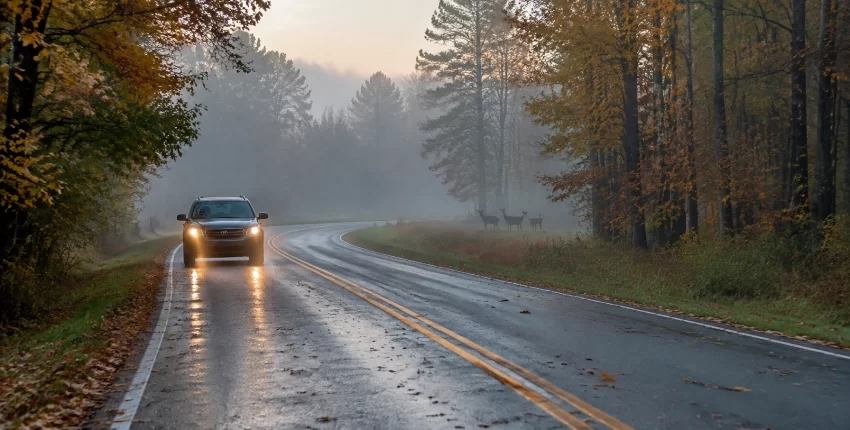
If you drive around Williamston or across rural Eastern North Carolina, October deserves your full attention. It marks the beginning of the state’s highest-risk stretch for animal-related crashes, when deer movement, shorter daylight, fog, wet leaves, and harvest traffic all begin affecting the way roads behave.
November may rank slightly higher than October in some statewide crash reports, but October is when the risk starts building quickly. The North Carolina Department of Transportation identifies October through December as the peak period for deer collisions, while the N.C. Wildlife Resources Commission warns that deer are especially active around daylight, dusk, and dark or foggy nights.
The goal is not to make you nervous every time you get behind the wheel. It is to help you recognize the conditions, prepare your vehicle, and know what to do if a collision happens.
Why October Raises the Collision Risk
Deer are moving more during the rut
White-tailed deer are common throughout North Carolina, including the fields, creek bottoms, wooded areas, and farm roads around Williamston. In early fall, deer movement increases as the breeding season approaches.
During the rut, deer may cross roads suddenly while chasing or avoiding other deer. Bucks can travel outside their usual areas, and does may move with several deer nearby. If one deer crosses in front of you, do not assume the road is clear. Others may follow seconds later.
The NCDOT’s deer collision guidance notes that deer movement increases from October through December because of mating and hunting seasons, while limited lighting makes animals harder to see.
Dawn, dusk, and fog reduce your reaction time
Many Eastern NC drivers are on the road during the exact times deer are most active. Morning commutes begin in low light, and evening trips often continue after the sun has gone down.
Fog creates another problem. It reduces contrast and makes it harder to see a deer standing at the edge of the road. In thick fog, your headlights may illuminate only a short distance ahead, leaving less time to react.
If you cannot see clearly beyond your stopping distance, reduce your speed. Use low beams in fog, and use high beams only when there is no oncoming traffic and conditions allow. Avoid relying on deer whistles or similar devices; the N.C. Wildlife Resources Commission says there is no scientific evidence that these devices reliably prevent collisions.
Wet leaves can make a sudden stop more dangerous
A layer of wet leaves can reduce tire grip and hide lane markings, potholes, and road-edge hazards. If you need to brake suddenly on leaf-covered pavement, your vehicle may not respond as quickly as it would on dry asphalt.
That is why following distance matters so much in October. Leave more room between your vehicle and the one ahead, especially on two-lane roads, curves, bridges, and routes through wooded or agricultural areas.
Harvest traffic adds another hazard
Fall harvest brings more farm equipment, trailers, delivery trucks, and slow-moving vehicles to rural roads. A tractor may appear around a bend with little warning, and a line of traffic behind it may be moving at different speeds.
Slow down when approaching agricultural equipment, stay patient, and do not pass unless you have a clear, legal view of the road ahead. The same defensive approach that helps you avoid a deer can also help you respond to a slow-moving truck or tractor.
How to Prepare Before October Driving Gets Difficult
You can reduce your risk with a few practical steps before the season becomes busy.
Adjust your driving habits
When driving near fields, woods, ditches, streams, or deer crossing signs:
- Slow down near dawn, dusk, and after dark.
- Scan both shoulders, not just the lane ahead.
- Keep extra space between your vehicle and other traffic.
- Use high beams when appropriate and when no traffic is approaching.
- Watch for more deer after seeing the first one.
- Make smooth braking and steering inputs on wet or leaf-covered roads.
If you see deer close to the road, reduce your speed immediately. A long horn blast may encourage them to move away, but keep your vehicle in its lane and remain prepared for additional deer.
Check tires and brakes
Your tires and brakes are your most important tools during an emergency stop. Before the season turns, check:
- Tire tread depth and air pressure
- Signs of uneven tire wear or sidewall damage
- Brake pad thickness and rotor condition
- Brake fluid level
- Headlight operation and lens clarity
- Windshield wiper condition
- Coolant and other fluid levels
If your vehicle pulls while braking, vibrates, takes longer to stop, or has a soft brake pedal, schedule an inspection before continuing to drive regularly. A visit to an auto repair shop in Williamston, NC can identify problems before they become an emergency.
If a Deer or Another Vehicle Is Unavoidable
A deer can appear so quickly that there may be no safe way to avoid contact. If a collision seems unavoidable, brake firmly while keeping the steering wheel straight. Do not swerve into oncoming traffic, a ditch, a tree, or another lane.
Swerving can turn a vehicle strike into a more serious rollover or multi-vehicle crash. Staying in your lane and maintaining control gives you the best chance of reducing the impact.
Always wear your seat belt, and make sure passengers are properly restrained. Your reaction may be limited to a second or two, but a seat belt can make a significant difference.
The First Five Minutes After a Collision
The moments immediately after a crash can be confusing. Focus on safety first and documentation second.
1. Get out of the travel lane if it is safe
If your vehicle can move and steering, braking, and tires appear functional, pull to a safe location away from moving traffic. Do not attempt this if the vehicle is badly damaged, leaking fluids, smoking, or difficult to control.
If the vehicle cannot move, keep your seat belt on when remaining inside is safer. Never stand in a travel lane or walk toward traffic.
2. Turn on your hazard lights
Activate your hazard lights as soon as possible. If you have warning triangles or flares and can place them without entering danger, use them to make the vehicle more visible.
3. Call 911 when anyone is hurt or the scene is dangerous
Call 911 if anyone has an injury, if a vehicle is blocking traffic, if there is a fuel or coolant leak, or if the crash involves significant damage. Let emergency responders determine whether medical attention or traffic control is needed.
If you hit a deer, do not approach or touch the animal. A frightened or injured deer can move unpredictably. Report the collision and follow instructions from law enforcement.
4. Document the scene
From a safe position, photograph:
- Vehicle damage from several angles
- The surrounding roadway and traffic conditions
- Skid marks, debris, and damaged signs or barriers
- License plates and insurance information
- Any visible animal or road hazard, without approaching it
Exchange contact and insurance information with the other driver. Avoid arguing about fault at the scene.
5. Do not leave a damaged vehicle in a travel lane
A vehicle sitting in the roadway creates a second collision risk. If it cannot be moved safely, stay in a protected location and request assistance. 24/7 emergency towing in NC can help remove the vehicle and transport it for inspection.
When You Should Call for a Tow
Not every collision requires a tow, but you should not drive a vehicle that may have hidden safety damage. Request towing services near Williamston if you notice:
- Fluid leaking onto the ground
- A strong pull while steering or braking
- Airbag deployment
- A damaged wheel, tire, axle, or suspension component
- Coolant leaking from the front of the vehicle
- A damaged radiator or major front-end structure
- A headlight, hood, or bumper interfering with visibility or tire movement
- Grinding, scraping, shaking, or unusual steering
- Warning lights that appear after the crash
A vehicle with only minor cosmetic damage may be safe to drive, but do not make that decision based on appearance alone. If the wheel is misaligned or the radiator support is damaged, driving farther could cause additional damage or leave you stranded.
What Collision Repair Actually Involves
A professional collision repair process begins with a complete estimate, not just a quick look at the bumper. A technician examines visible damage and checks for problems behind the panels.
The shop may evaluate:
- Frame and structural alignment
- Suspension and steering components
- Radiator and cooling systems
- Lighting, sensors, and electrical connections
- Hood, fender, bumper, and support damage
- Paint and panel fit
The repair facility can also coordinate with your insurance company, provide photographs, and update the estimate if hidden damage is discovered after disassembly.
Cosmetic damage and structural damage are not the same. A bumper cover may be replaceable while the reinforcement, frame rail, or mounting points behind it also require repair. Paint matching matters, too. A quality repair should blend the finish so the repaired section does not stand out from the rest of the vehicle.
Be cautious of the lowest quote if it does not explain what is included. The “best price” can hide skipped inspections, reused damaged parts, incomplete paint work, or unresolved frame problems. A proper estimate should prioritize safe operation and complete repairs, not just making the vehicle look acceptable from a distance.

Get Ready Before You Need Help
October driving in Eastern NC does not have to be stressful. Slow down when visibility is poor, watch the shoulders, leave extra following distance, and make sure your tires and brakes are ready for sudden stops.
If a collision does happen, move out of traffic when safe, turn on your hazards, call 911 for injuries or dangerous conditions, and have the vehicle inspected before deciding to drive it again.
Platinum Towing NC brings more than 26 years of hands-on experience, certified technicians, 24/7 emergency towing, and a one-stop automotive model to drivers in Williamston and surrounding areas. When your vehicle needs help, you can be towed in, inspected, repaired, and put back on the road by one dependable team. For emergency towing or collision-related auto repair, contact Platinum Towing NC today.